Description
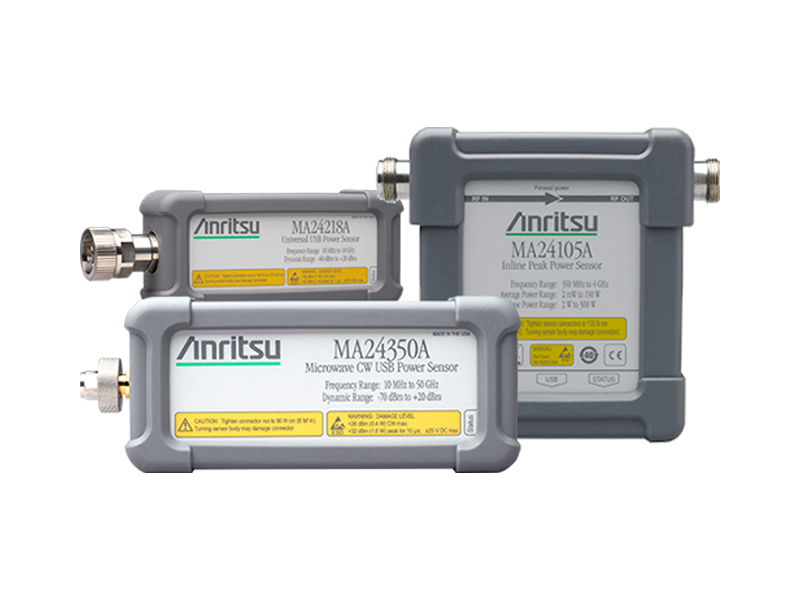
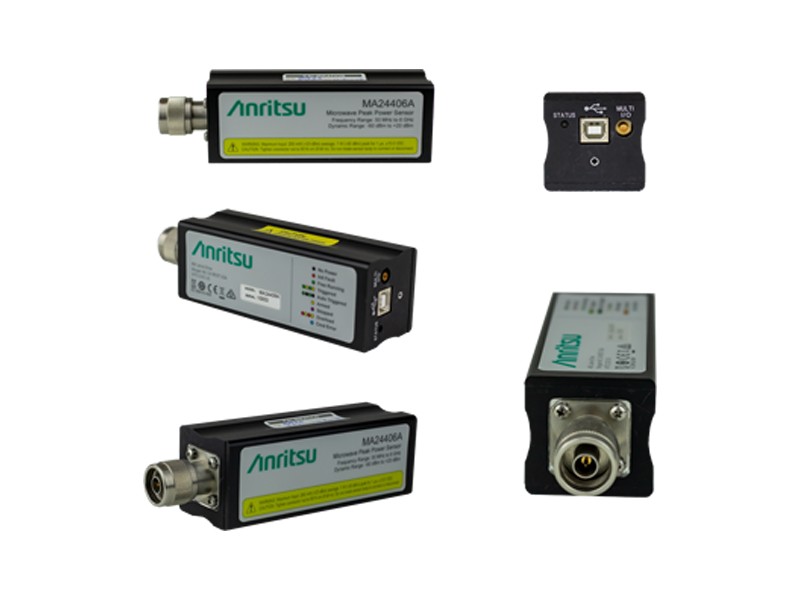
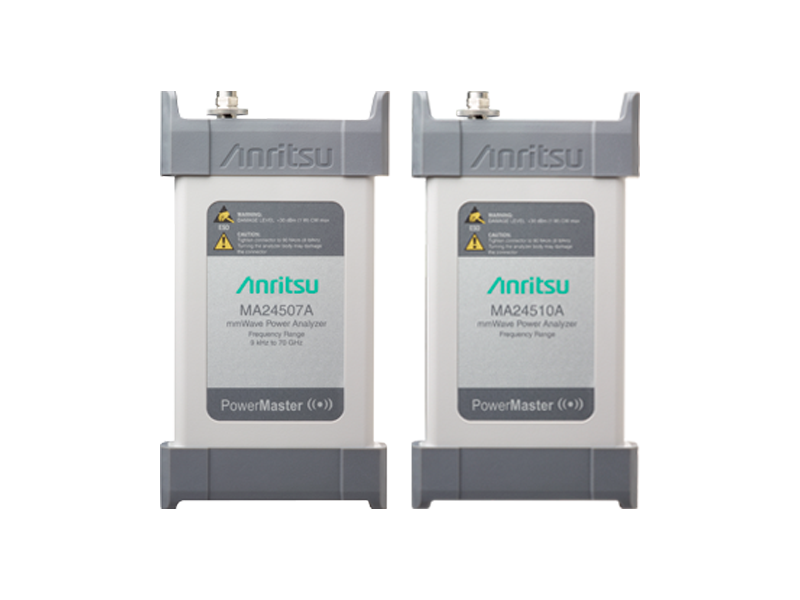
With seven different families of power sensors (including USB sensors*) to choose from, you can trust you’ll find the right combination for precision power measurement, whatever your application requirements might be.
Power Sensors for Every Application:
Anritsu’s power sensors have been designed with just one thing in mind: everything. The range of sensors provide frequency coverage to 50 GHz, with dynamic range up to 90 dB, and includes both diode and thermal based technologies.
The Anritsu diode-based sensors offer speed, sensitivity, and dynamic range with designs using half- or full-wave diode rectifiers constructed from zero-bias Schottky diodes. The rectifier output is low-pass filtered, forming an envelope detector. This post-detection bandwidth is sometimes referred to as the video bandwidth and is a measure of how quickly the power sensor can respond to a changing input signal, such as a radar pulse or a multi-carrier OFDM signal.
Standard Diode Sensors: MA2470D:
Designed for high dynamic range, high accuracy CW, and TDMA measurements, these power sensors have 90 dB dynamic range and linearity better than 1.8%. This makes them the choice for precision measurements. The rise-time of these sensors is fast enough for power measurements on GSM and similar TDMA systems that use GMSK modulation.
High Accuracy Diode Sensors: MA2440D:
With its built in 3 dB attenuator, the MA2440D sensors minimize VSWR input. They are typically used when high measurement accuracy is required over a large dynamic range, for example when measuring amplifiers. High accuracy diode sensors have a dynamic range of 87 dB compared to the 90 dB of standard diode sensors. In all other respects, the performance of the sensors is identical to the standard diode sensor.
Universal Power Sensors: MA2480D:
The MA2480A series are true RMS sensors with a dynamic range of 80 dB. These power sensors are modulation independent and can be used for average power measurements on a wide variety of signals, including multi-tone or W-CDMA signals. The sensor architecture consists of three pairs of diodes, each one confi gured to work in its square law region over the dynamic range of the sensor. Option 1 provides TDMA measurement capability, calibrating one of the diode pairs for linearity over a wide dynamic range.
Thermal Power Sensors: MA24000A:
The Anritsu MA2400xA series thermal sensors provide excellent power measurement accuracy over 50 dB of dynamic range. Thermal sensors use Seebeck elements where the combined effect of a thermal gradient and charge migration between dissimilar metals gives a true reading of the average power of any incident waveform. Anritsu thermal sensors have class leading SWR and a built-in EEPROM with calibration factor and linearity correction data. This results in assured accuracy when measuring any signal.
Features
- True-RMS detection enables accurate average power measurements of any signal type
- 50 dB dynamic range
- Wide frequency coverage from 10 MHz to 50 GHz (sensor dependent)
- Calibration factors stored in EEPROM
Application
Sensor EEPROM:
The family of Anritsu power sensors store calibration data and model information within internal EEPROMS. User calibration factor tables allow frequency points or compensation for test system loss, including that from couplers and attenuators.
High Power Applications:
Traditional high-power sensors are expensive and have degraded accuracy specifications. Having additional specialized sensors lead to more annual calibrations requiring more down time and expense. Using user calibration factor tables coupled with a precision high power attenuator avoids these problems and eliminates the need for specialized, high-power. Users can easily reduce operating costs and save time:
- Compensation can be made for any precision attenuator or coupler by entering frequency and attenuation values into the user calibration factor table in the internal EEPROM.
- The attenuation device can be semi-permanently attached. The power meter automatically applies compensation during the 0.0 dBm, 50 MHz calibration reference process.
- User calibration factor tables are easily deactivated – allowing the power sensor to be used as a stand-alone device.
- Up to six tables can be stored.


Reviews
There are no reviews yet.